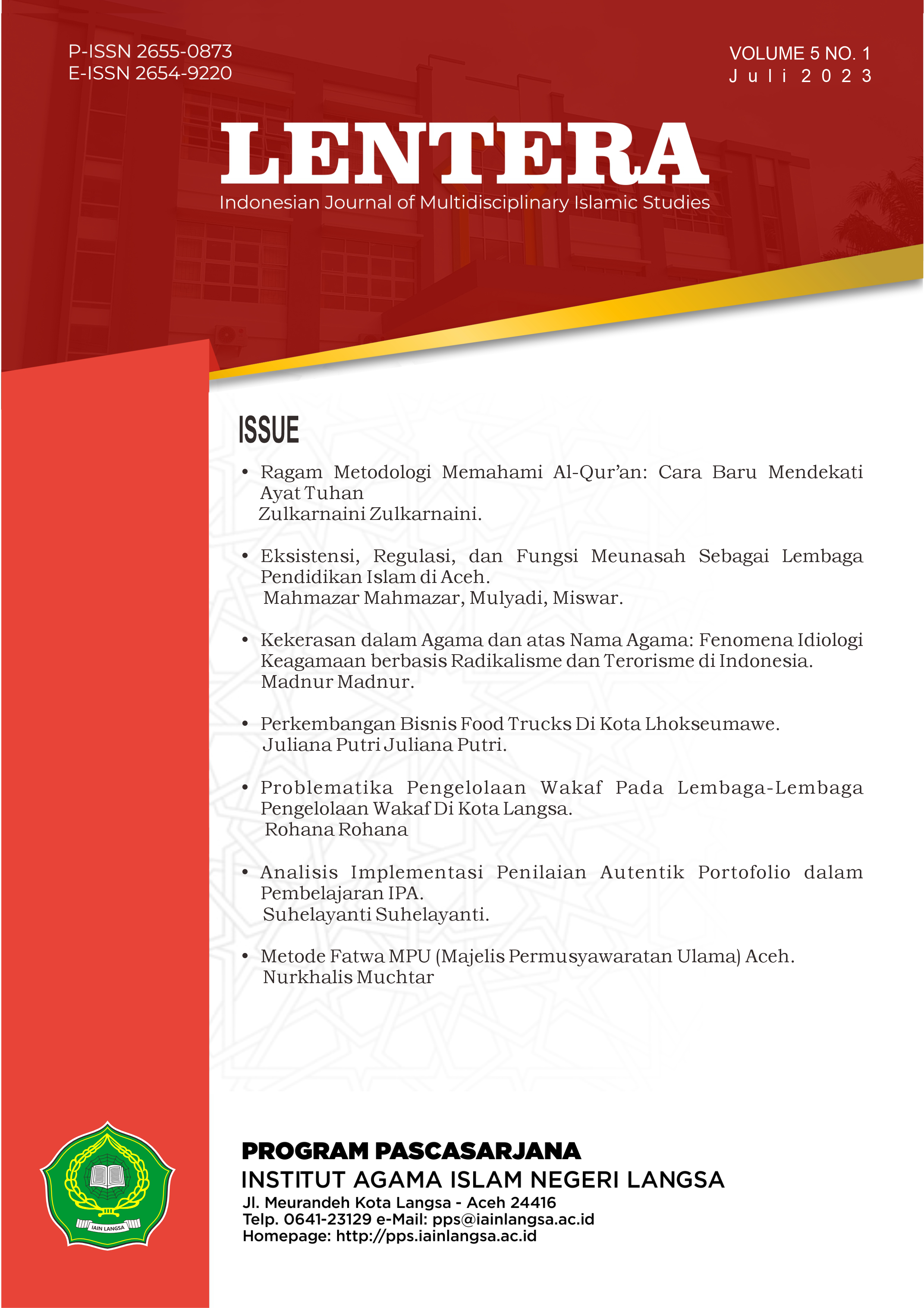
Ragam Metodologi Memahami Al-Qur'an: Cara Baru Mendekati Ayat Tuhan
DOI:
https://doi.org/10.32505/lentera.v5i1.5454Keywords:
Al-Qur'an, interpretation, methodology, hermeneutics, rationalAbstract
This article aims to explore various approaches that can be taken in building a paradigm to understand the meaning in the Qur'an. As the guide of mankind, the Qur'an has been uniformly understood throughout its history. The development of the times and the development of science demand new ways of studying the Qur'an, so that reading the Qur'an requires many approaches. Using a qualitative approach, this research uses a literature review. Various references are used related to the theme of the article. The research findings show that there are several methodologies that can be used to build a paradigm basis for understanding the Qur'an. The traditional methodology is the most popular approach because this approach is based on belief. Rational methodology is the basis of the most controversial approach, but very urgent in the development of science. The linguistic methodology becomes an approach that is able to present a very effective explanation of the text of the Qur'an. The hermeneutic methodology, although it is wary of many traditional thinkers, offers a method of understanding the Qur'an contextually.Downloads
References
Ahmad. (n.d.). Musnad al-ImÄm Ahmad Vol. 1 No. 2397. Kairo: Mu’assasah Qurtubah.
Al-RahmÄn, K. ‘Abd. (1986). UsÅ«l al-TafsÄ«r wa QawÄ‘iduh. Beirut: DÄr al-NafÄ’is.
Al-SÄlih, S. (1977). MabÄhits fÄ« ‘UlÅ«m al-Qur’Än. Beirut: DÄr al-‘Ilm li al-MalÄyÄ«n.
Al-SuyÅ«tÄ«. (n.d.). Al-ItqÄn fÄ« ‘UlÅ«m al-Qur’Än. Kairo: MustafÄ al-BÄbÄ« al-HalabÄ«.
Al-Turmudhī. (n.d.). Sunan al-Turmudhī Vol. 5 No. 2951. Beirut: Dar Ihya’ al-Turats al-’Arabi.
Asari, H. (1994). Yang Hilang dari Pendidikan Islam: Seni MunÄdharah. Ulumul Al-Qur’an, 5(1), 62–68.
Ast, F. (1808). Grundlinien der Grammatik. Lanshut: Thomann.
Baidan, N. (n.d.). Metodologi Penafsiran al-Qur’an. Yogyakarta: Pustaka Pelajar.
Baum, G. (1975). A Theological Reading of Sociology. New York: Paulist Press.
Biyanto, B. (2015). Pluralism in the perspective of Semitic religions. Indonesian Journal of Islam and Muslim Societies, 5(2), 255. https://doi.org/10.18326/ijims.v5i2.255-282
Booth, W. C. (1979). Critical Understanding: The Power and Limits of Pluralism. Chicago: University of Chicago Press.
Elkarimah, M. F. (2018). Pendekatan Linguistik Syahrur Pada Ayat Poligami. MAGHZA: Jurnal Ilmu Al-Qur’an Dan Tafsir, 3(2), 164–174. https://doi.org/10.24090/maghza.v3i2.2129
Ethier, M.-A., Lefranceois, D., & Demers, S. (2013). An Analysis of Historical Agency in Québec History Textbooks. Education, Citizenship and Social Justice, 8(9), 119–133. https://doi.org/10.1177/1746197913483649
Gätje, H. (1997). The Qur’Än and Its Exegesis. Oxford: Oneworld.
González, J. L. (1990). Mañana: Christian Theology from a Hispanic Perspective. Nashville: Abbingdon Press.
Ismail, N. B. (2017). The Quranic Exegesis, Reformism, and Women in Twentieth Century Indonesia. Studia Islamika, 24(3). https://doi.org/10.15408/sdi.v24i3.5187
Izutsu, T. (1996). Ethico-Religious Concepts in the Qur’Än. Montreal: McGill University Press.
Jacobsen, D. (2000). Multicultural Evangelical Hermeneutics and Ecumenical Dialogue. Journal of Ecumenical Studies, 37(2), 133–137.
Jary, D., & Jary, J. (1991). The Harper Collins Dictionary of Sociology. New York: Harper Collins.
Khaldūn, I. (1930). Muqaddimah. Kairo: Al-Matba‘ah al-Azhariyyah.
Legenhausen, M. (2002). Satu Agama atau Banyak Agama. Jakarta: Lentera Basritama.
Malik, A. D., & Trisnowati, A. Z. D. Y. (2018). The performance of MSMEs of Gresik based on maqasid sharia. Journal of Economics, Business & Accountancy, 21(3), 315 – 322. https://doi.org/10.14414/jebav.v21i3.1244
Miswari, M. (2017). NASIB FILSAFAT DI TANGAN BAHASA: EVALUASI KRITIS FILSAFAT ANALITIK, STRUKTURALISME DAN DEKONSTRUKSI. Retrieved from http://journal.iainlangsa.ac.id/index.php/jl3t/article/view/19
Muhammad RasyÄ«d RidÄ. (1973). TafsÄ«r al-ManÄr. Beirut: DÄr al-Fikr.
Nasrudin, N. (2016). MANHAJ TAFSIR MOHAMMAD ARKOUN. MAGHZA: Jurnal Ilmu Al-Qur’an Dan Tafsir, 1(1), 85–92. https://doi.org/10.24090/maghza.v1i1.698
Nasution, I. F. A., & Miswari. (2018). Menangkap Pesan Tuhan: Urgensi Kontekstualisasi Alquran melalui Hermeneutika. Jurnal At-Tibyan, 3(2), 223–237.
Palmer, R. E. (1969a). Hermeneutics: Interpretation Theory. Evanston: Northwestern University.
Palmer, R. E. (1969b). Hermeneutics. Evanston: Northwestern University Press.
Richards, G. (1989). Toward a Theology of Religions. London: Routledge.
Salikun, F. R. (2015). Paradigma Baru Hermeunetika Kontemporer Paul Ridoeur. Hermeunetik, 9(1), 161–184. https://doi.org/10.1017/CBO9781107415324.004
Sirry, M., & Omar, A. R. (2014). Muslim Prayer and Public Spheres: An Interpretation of the Qur’anic Verse 29:45. Interpretation: A Journal of Bible and Theology, 68(1), 39–53. https://doi.org/10.1177/0020964313508736
Sukidi. (2009). Nasr HÄmid AbÅ« Zayd and the Quest for a Humanistic Hermeneutics of the Qur’Än. Die Welt Des Islams, 49(2), 181–211. https://doi.org/10.1163/157006009X458393
Syahbah, M. A. (n.d.). Al-IsrÄ’īliyyÄt wa al-Mawdū‘Ät fÄ« Kutub al-TafsÄ«r. Kairo: Maktabah al-Sunnah.
Wolf, F. A. (1831). Vorlesung uber die Enzyklopadie der Altertumswissenschaft (J. D. Gürtl, ed.). Leipzig: Lehnhold.
World, D. B. and H. (1990). Dialogism: Bakhtin and His World. London and New York: Routledge.



.jpg)