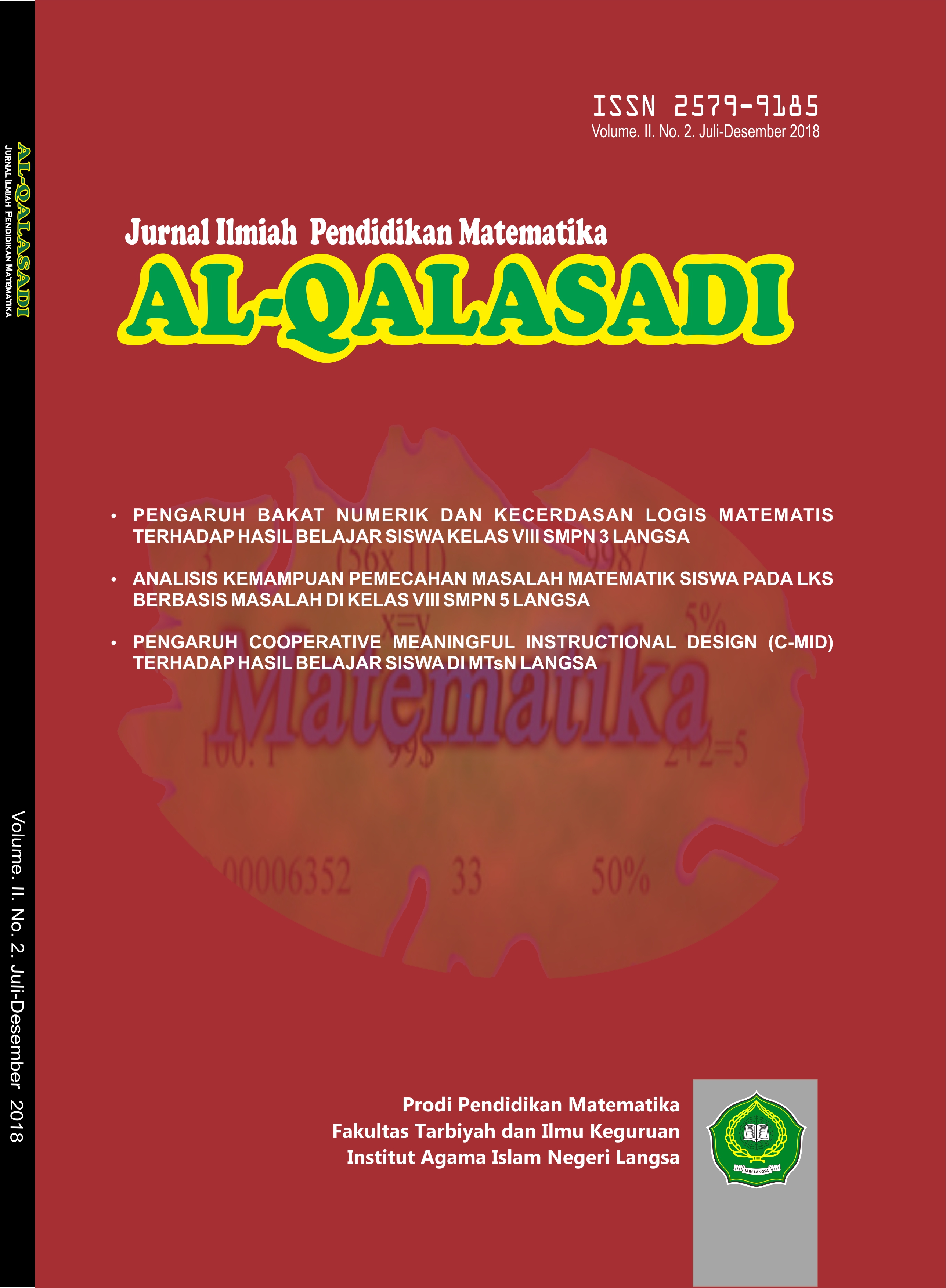
PEMANFAATAN MEDIA AUDIO VISUAL BERBASIS REALISTIC MATHEMATICS EDUCATION (RME) TERHADAP KEMAMPUAN PEMECAHAN MASALAH SISWA MTsS RAUDHATUN NAJAH LANGSA
DOI:
https://doi.org/10.32505/qalasadi.v2i2.797Keywords:
Media Audio Visual, Realistic Mathematics Education (RME), Kemampuan Pemecahan MasalahAbstract
Penelitian ini bertujuan untuk mengetahui pengaruh pemanfaatan media audio visual berbasis Realistic Mathematic Education (RME) terhadap kemampuan pemecahan masalah siswa di MTsS Raudhatun Najah Langsa. Metode dalam penelitian ini adalah metode eksperimen kuasi dengan dengan pendekatan kuantitatif, rancangan penelitian ini menggunakan rancangan pretest-posttest control group design. Populasi dalam penelitian ini adalah seluruh siswa kelas VII MTsS Raudhatun Najah Langsa yang berjumlah 96 siswa, sampel dalam penelitian ini dipilih secara random sampling, maka didapat kelas eksperimen adalah kelas VII.a berjumlah 31 siswa dan kelas kontrol adalah kelas VII.b berjumlah 31 siswa. Instrument yang digunakan adalah tes yang berbentuk uraian sebanyak 5 butir soal. Teknik pengumpulan data mengunakan tes kemampuan pemecahan masalah. Hasil pengujian hipotesis yang dilakukan pada taraf signifikan dan dk = (n1 + n2 – 2) = (31 +31 – 2) = 60 dengan kriteria tabel thitnugtabel sehingga diperoleh -2,00 5,99 2,00 sehingga H0 ditolak sehingga dapat disimpulkan bahwa terdapat pengaruh pemanfaatan media audio visual berbasis Realistic Mathematic Education (RME) terhadap kemampuan pemecahan masalah siswa di MTsS Raudhatun Najah Langsa.
Downloads
Downloads
Published
Issue
Section
License
Copyright Notice
Authors who publish with this journal agree to the following terms:
Authors retain copyright and grant the Jurnal Ilmiah Pendidikan Matematika Al Qalasadi of first publication with the work simultaneously licensed under a Creative Commons Attribution License (CC BY 4.0) that allows others to share the work with an acknowledgment of the work's authorship and initial publication in this journal.
Authors are able to enter into separate, additional contractual arrangements for the non-exclusive distribution of the Jurnal Ilmiah Pendidikan Matematika Al Qalasadi published version of the work (e.g., post it to an institutional repository or publish it in a book), with an acknowledgment of its initial publication in this journal.
Authors are permitted and encouraged to post their work online (e.g., in institutional repositories or on their website) prior to and during the submission process, as it can lead to productive exchanges, as well as earlier and greater citation of published work (See The Effect of Open Access)